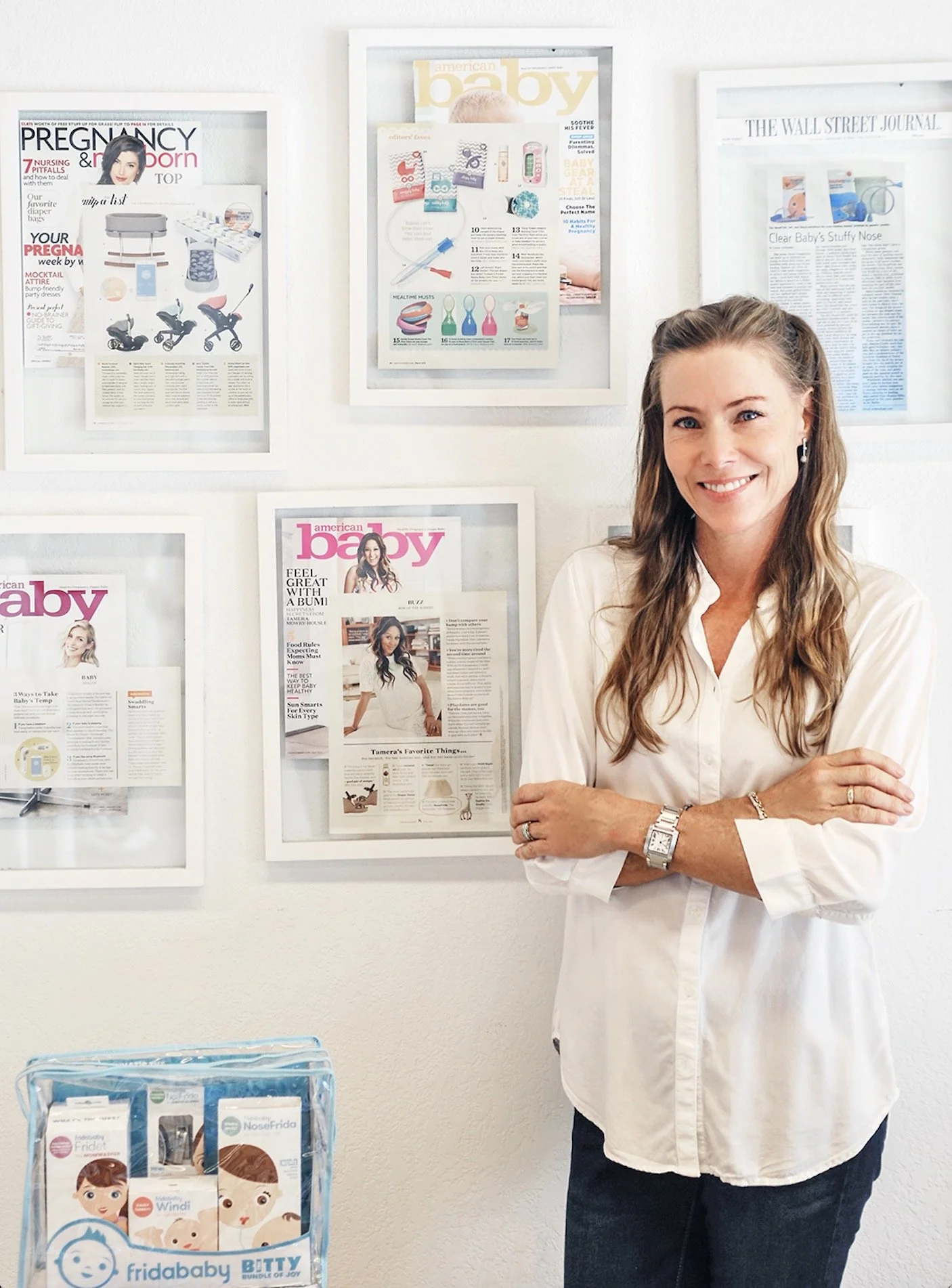
How Kaisa Levine built Fridababy
Fridababy started with a problem that needed solving. Turning it into a baby care business worth millions took extraordinary marketing, cross-cultural bridging, and a whole village of family members, doctors, and mothers.
The seeds of the business were planted in 2002, when Kaisa Levine was in Sweden to introduce her six-week-old son to her family — a homecoming for the 37-year-old, who had moved to the U.S. during her gap year, built a career as an emergency medical technician in New York, and was now a new mother living in Miami Beach with her husband Doug.
But as babies do, her son disrupted the trip by coming down with a terrible cold. Her friends told her about NoseFrida, a tube used to clear an infant's nose. As a mother and former EMT, she had no qualms about the "snot sucker." In minutes, her son could breathe freely again.
Levine started bringing NoseFridas back to the U.S. and sharing them with other new mothers and her Miami Beach pediatrician, who sold them out of her office for $20 each. Then one night in 2007, the pediatrician called. A patient's child was very sick — she didn't want to send her to the hospital just for suctioning. Did Kaisa have any NoseFridas?
"She came to my house at 10 at night," Levine recalls. "I met her at the front door, and she gave me $20. I gave her a NoseFrida. I came inside and said to Doug: 'People are coming to my house at night. I think we need to do this.'"
That mother's need told Levine she had a real business on her hands.
Building on a distribution agreement she had struck with NoseFrida’s inventor, Levine imported 2,000 units, built a website on Yahoo Shopping, and started selling from her house. Total startup capital: under $5,000.
What happened next had nothing to do with venture money, a marketing team, or advertising. It had everything to do with trust — and Levine's understanding of exactly where new mothers placed it.
The Doctor Strategy
Levine's first insight was that new parents trust their pediatrician more than any advertisement. So she went to see pediatricians — in Miami, New York, and Los Angeles — walked in unannounced, demonstrated the device on the spot, and left free samples. Then she asked each doctor a specific question: Which pharmacies do your patients actually use?
She called those pharmacies next.
To get independent stores to take a chance on an unknown product from an unknown company, she offered a buy-back guarantee. Stock it; if it doesn't sell in six months, she'd take it back. She knew it would sell — and when a store was slow to move inventory, she'd send friends in to buy.
She worked her way down a handwritten list of the top 20 independent baby retailers in the country. Her first major boutique account was the Pump Station in Santa Monica in 2008. When the Pump Station placed its first order of a dozen units, and Levine was out of stock, Doug drove an hour south to Baptist Hospital, bought them outright from the pharmacy, pulled the tags, and shipped them to California that day. The Pump Station got its order. The relationship held.
She also understood that she was selling to sleep-deprived parents in crisis. When a customer placed an online order at 3 a.m. — which happened regularly, because a 3 a.m. order for a nasal aspirator means a sick baby, right now — Levine would call them. She had already found a pharmacy nearby that stocked NoseFrida. She had already called ahead to hold one.
"By the time your order arrives," she'd tell them, "your baby's cold will be gone."
It was customer service. It was also how she built a distribution network, one pharmacy relationship at a time. If someone complained, she sent a replacement, no questions asked.
Chicago
The Swedish manufacturer told Levine early on that she would never crack the American market. Poland, they said, was moving tens of thousands of units a month. The U.S. was different. Levine found the Polish community in Chicago. Polish mothers already knew NoseFrida; they just didn't know it was available here. She noticed the pattern in her orders — Polish surnames, Chicago zip codes — called one of the customers, and asked: "Is there a pharmacy your community uses?” There was. She called it, explained that a cluster of mothers in the neighborhood were about to come looking for this product, and offered the same buy-back guarantee she'd been using everywhere else. Then she told the customer to spread the word: go buy it there, in person, today.
Chicago became one of her strongest early markets, built almost entirely through ethnic community networks and independent drugstores, with no advertising budget. The only paid promotion NoseFrida ever ran in its early years was a $100 mention on a parenting podcast called Dad Labs, arranged over drinks at a trade show.
Word of Mom
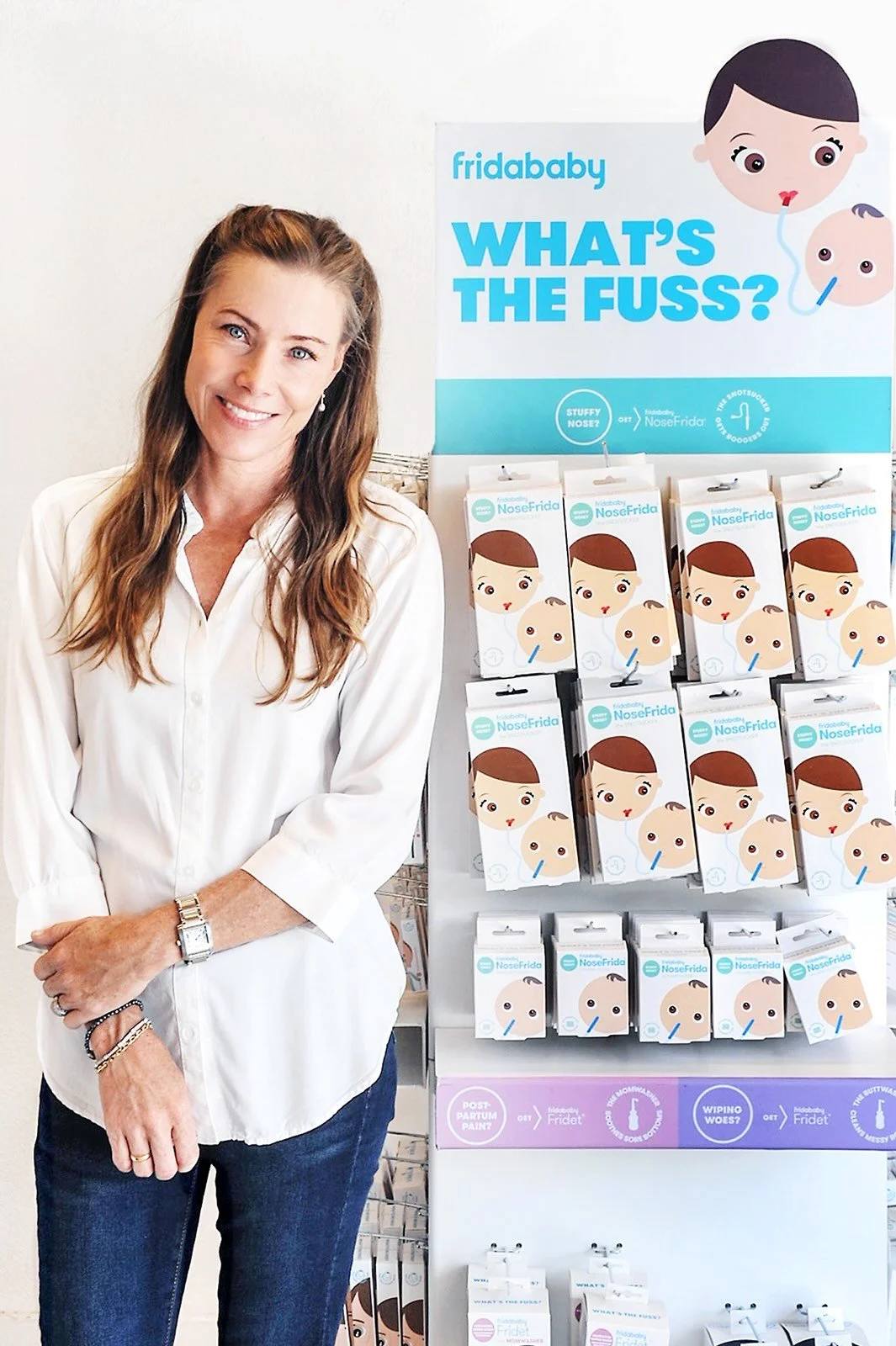
Before Instagram, there were chat rooms. Urbanmom.com. Cafemom.com. Levine would ask happy customers to post about the product — which pharmacy they'd found it at, what they thought of it. That was the social media of the time, and she worked it the same way she worked everything else: methodically, personally, one relationship at a time.
Then Victoria Beckham tweeted about using the NoseFrida with her baby daughter Harper, triggering tabloid stories and providing unsolicited celebrity validation at a pivotal moment in the brand's national expansion. The actress Ali Landry, whom Levine and her partner Sarah Perilli had charmed at a conference in Los Angeles, called it “the grossest thing you’ll ever love” and spread the word among that city's mom network. A home-visiting pediatrician who served wealthy Hamptons families recommended it to every patient. He sent them to Bigelow's Pharmacy in New York City to buy it.
A single post on a parenting blog accelerated the brand in ways no ad buy could have matched. Lauren Jimeson of Babble cut open a traditional bulb aspirator and photographed what was inside: mold. The post went viral among new parents. NoseFrida — transparent and fully washable — was the obvious alternative. Levine had nothing to do with the post. She didn't need to; other mommy bloggers spread the word, often mentioning the NoseFrida specifically.
That was the engine: word of mom, word of pediatrician, key pharmacies, key boutique retailers — each link reinforcing the next.
The Home Office
For years, the company operated out of the Levines' home in Miami Beach. The core team was four or five people — Kaisa, Sarah, and a small group who worked alongside them. Sarah had been hired in 2008 initially to cover order fulfillment during Kaisa's summers in Sweden. She was young, tech-savvy, and talented, and she grew into a full operational partner. Eventually, Levine gave her 20% equity.
To keep the team together and out of their cars at lunch, Levine cooked for everyone every day. They ate outside. Twenty-five minutes, then back to work. The warehouse, when they eventually got one, ran the same way: good music, snacks, dogs welcome, people trusted to do their jobs. Nobody was formally anyone else's boss.
Meanwhile, Levine’s home garage was filling up. Levine would make runs to a storage unit every couple of days, loading boxes into the SUV and transferring them to the house. Eventually, wooden pallets started arriving directly. At peak, they fit 14 pallets into the double-car garage.
The kids helped after school. "Put your stuff down," Levine would tell them. "FedEx is coming." Cardboard and tape, everyone pitching in.
Then Babies R Us came aboard, ordering roughly 20,000 units per month, picked up by a trucking company. The pallets had to be packed to a specific height. The garage doors weren't tall enough to do it inside. So they packed in the driveway, watching the weather, hoping it wouldn't rain.
"After a few months of this," Levine says, "we said: this is getting ridiculous."
In 2012, they leased their first warehouse, at 38 NW 24th Street in Wynwood — back when Miami’s Wynwood arts district was still warehouse country.
The Numbers
Fridababy’s expansion from direct sales to retail began in 2008, when Levine struck a deal with Whole Foods for regional distribution — approximately 10 stores in Oregon, Washington, and Northern California — driven by recommendations from doctors and nurse practitioners.
A national retail sweep followed: Target, Babies R Us, CVS, Walmart. The Walmart baby buyer told Levine’s team it was the first time she had ever called a supplier. She ordered units for every store.
In 2010, Amazon shifted from consignment to buying NoseFrida inventory outright and actively promoting it. The Levines were on a spring break trip with their children to Costa Rica when Sarah called with the news. The day the Amazon terms changed, the company did tens of thousands of dollars in sales.
The Walgreens account came through an improvised pitch in Minneapolis. The buyer liked the product but had a problem: her pegboard held 35 SKUs, and NoseFrida took up two of them — the device and a separate pack of filters. Doug proposed a bundle on the spot: package the device with 10 filters, one SKU. She said she'd be inclined to order nationwide. They made it happen.
By 2013, Fridababy’s pitch book documented 200,000 NoseFrida units annually on Amazon alone, 130,000 at buybuy BABY, 55,000 across 199 Whole Foods locations, 20,000 units per month at Babies R Us. Four consecutive years of 100% growth.
A Growing Brand
Nosefrida USA LLC became Fridababy in 2010 — a deliberate move to signal that this was a brand, not a single product. The URL moved from nosefrida.com to fridababy.com. By then, it had two products – NoseFrida and Windi, a gas-relief device from the same Swedish manufacturer.
Next to join the line was Fridet, a butt-washer for toddlers and new mothers. By 2013, the company had prototyped a swaddling blanket and toothbrush that would go on to be successful products. Retailers that had once needed persuading now accepted every new Fridababy product without hesitation — because the original had never needed a co-op ad, never required a promotional fee, and never failed to sell.
The Sale
In July 2016, Levine sold a majority interest in Fridababy to Garnett Station Partners, a New York private equity firm. The company she had started with under $5,000 and no outside capital was generating $30 million in annual revenue and $7 million in EBITDA at the time of sale.
Levine had hired her neighbor, Chelsea Hirschhorn, as CEO of the fast-growing company in 2014, so she could focus more on her children during their teenage years. Hirschhorn stayed on through the sale and would go on to lead the company to new heights.
Levine retained a minority stake through the Garnett Station transaction. When SC Johnson acquired Fridababy in 2020, she sold her remaining shares.